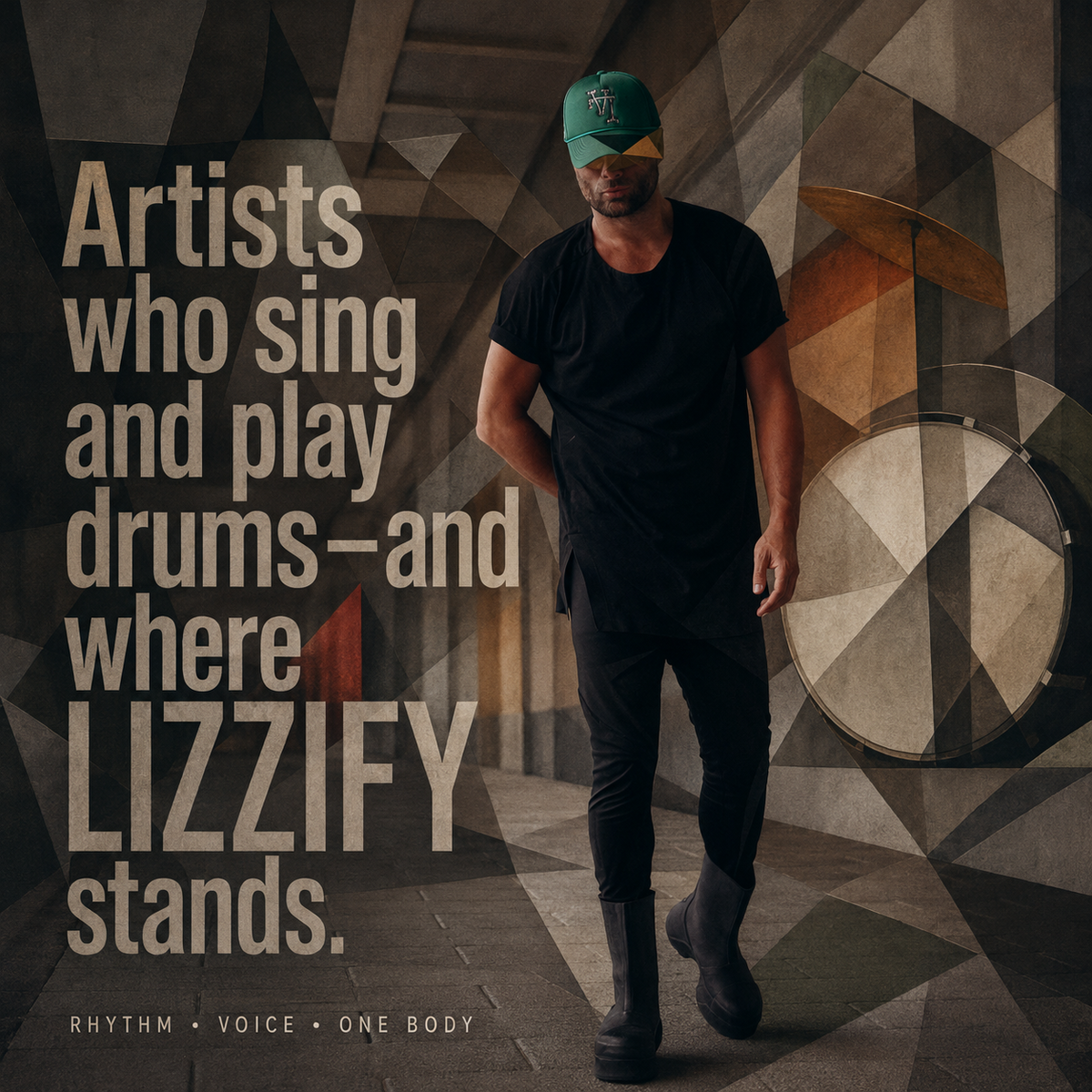
The argument
The phrase singer-drummer can sound like a circus trick: two difficult tasks performed at once. That framing misses the art. The real test is whether the rhythm and the voice feel authored by the same body, or whether one skill merely survives while the other takes the spotlight.
Paul Lizzi’s lane begins with the drums, not with a marketing label. Drum Luvin’ made the instrument the hook, the image and the identity before the catalogue widened into vocals, production, films and five albums. The controversial position is that technical multitasking means little unless it changes the song’s character. Coordination is impressive. Authorship is memorable.
Inside the video
The featured tape is “PAUL LIZZI | DRUM LUVIN' | OFFICIAL | VS Big Bass Ft. NESSA,” published on Paul’s official YouTube channel on July 17, 2010. Paul’s official site identifies the track and its visuals as Mad Max-inspired. The current archive places it in Montréal at the breakthrough and documents the central creative decision: the drums are not background equipment; they function as hook, image and identity.
That gives the video two verified layers worth preserving. Its post-apocalyptic visual language builds a world around the performance, while the instrument itself becomes the front-person image. The exact upload title also preserves the VS Big Bass and NESSA credit. This is not a later story invented around an old clip. The original frame already announces what Paul intends to be known for.
Phil Collins proved the instrument can lead
The Rock & Roll Hall of Fame’s 2026 profile describes Phil Collins as a drummer, singer, songwriter and producer who first rose behind the kit before becoming a lead voice. That history is relevant as a craft reference, not as an implied connection to Paul. Collins demonstrated that the drummer’s sense of placement can shape songwriting, production and a public identity far beyond a solo break.
The lesson is not to imitate his sound. It is to reject the idea that a drummer must disappear behind the song. When the musician responsible for pulse also carries melody and narrative, rhythm can influence every decision rather than arriving after the composition is finished.
Anderson .Paak made the lane feel current
The Recording Academy identifies Anderson .Paak as a drummer who began playing seriously in church at age eleven. His recording career gives a newer R&B and hip-hop audience another visible model of rhythm and front-person energy sharing one identity. Again, this is comparison, not collaboration, endorsement or claimed influence.
Collins, .Paak and Lizzi come from different histories, genres and levels of recognition. The useful connection is structural: none of them needs the drum kit to be treated as a cage. The instrument can be an engine for voice, arrangement, stage movement and character.
Where LIZZIFY stands
Drum Luvin’ is the origin tape, but it is not the entire argument. Watch the 2012 “Drum Luvin’ | Paul Lizzi | Mashup” next, then move into M.O.T.H. on MultiVerse and the live GAIN signal from First$$$. The thread is not genre. It is Paul repeatedly turning rhythm into the doorway for a larger artist world.
That line now reaches WEN LAMBO and the current Z11VFY album after MultiVerse, Vici, First$$$ and Oscura. LIZZIFY is where the archive explains the transformation: drummer became singer, singer became producer, and the identities kept widening without deleting the pulse that started everything. The singer-drummer lane is not where Paul is trapped. It is where the whole five-album journey learned to move.